

How Thermal Break Aluminium Profile Improves Building Energy Efficiency?
Date: 2026-06-22Views: 18
One of the most common misunderstandings we encounter during window and curtain wall projects is that many buyers focus heavily on glass specifications while paying far less attention to the aluminium frame itself.
In reality, even high-performance double glazing or triple glazing can lose much of its energy-saving advantage if the aluminium profile creates a direct thermal bridge between indoor and outdoor environments.
After supporting projects in the Middle East, Europe, North America, and Australia, we have found that the frame system often plays a decisive role in determining whether a building can achieve its energy-efficiency targets. This is particularly true for large curtain wall façades, commercial buildings, and high-end residential developments where heating and cooling costs represent a significant portion of long-term operating expenses.
That is precisely why thermal break aluminium profiles have become a standard requirement in modern energy-efficient building design.
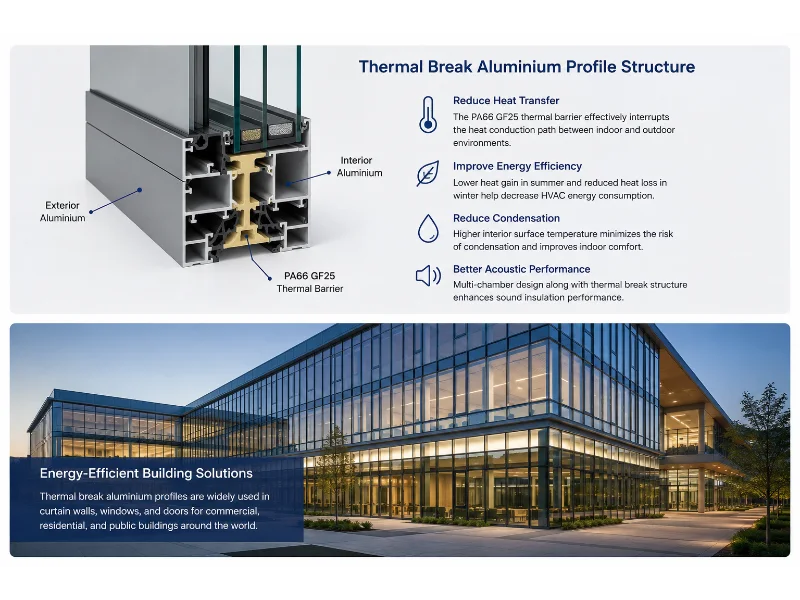
A thermal break aluminium profile uses a PA66 GF25 polyamide barrier to separate interior and exterior aluminium sections, reducing heat transfer and improving building energy efficiency.
How a Thermal Break Aluminium Profile Is Actually Constructed
A thermal break aluminium profile is not simply an aluminium extrusion with additional insulation. It is a composite structural system designed to interrupt the natural heat flow through aluminium.
The basic concept involves separating the interior and exterior aluminium sections with a low-conductivity thermal barrier, most commonly PA66 GF25 polyamide strips reinforced with 25% glass fiber.
The thermal barrier acts as an insulating bridge between two aluminium components, significantly reducing heat transfer while maintaining structural strength.
At Shenghai Global, the majority of our production uses the strip insertion thermal break system, which is widely regarded as the most reliable and durable solution for high-performance windows, doors, and curtain wall systems.
The manufacturing process generally consists of three critical stages:
Knurling
Before assembly, specialized knurling machines create serrated grooves inside the aluminium profile channels. This step serves several purposes:
- Removes surface coating residue
- Increases mechanical grip
- Creates a secure bonding surface for the thermal barrier
One common mistake some manufacturers make is insufficient knurling depth. During quality inspections, this issue often becomes visible only after pull-out testing, where inadequate mechanical engagement can lead to reduced long-term structural stability.
Polyamide Strip Insertion
The PA66 GF25 thermal barrier strips are inserted into the prepared channels of both aluminium profile sections. The dimensional accuracy of the strip and extrusion channel is critical. Excessive tolerance variation can affect assembly quality and long-term performance.
Crimping and Rolling
This is the most critical stage of the entire process. High-pressure rolling equipment mechanically locks the aluminium sections onto the polyamide strips, forming a single composite profile.
From factory production experience, the rolling process is where quality differences between manufacturers often become apparent. Improper rolling pressure can weaken the bond between aluminium and the thermal barrier, particularly in regions where building components are exposed to extreme temperature fluctuations.
For this reason, reputable manufacturers typically perform pull-out tests, shear tests, and dimensional inspections before profiles are released for fabrication.
An important detail often overlooked by buyers is that thermal break assembly is normally performed after surface treatment processes such as powder coating or anodizing. This prevents high-temperature curing cycles and chemical treatment processes from damaging the polyamide material.
Why Thermal Performance Has Become a Global Building Priority
Energy efficiency is no longer just an environmental objective. It has become a major financial consideration for building owners, developers, and facility managers.
Energy prices continue to rise, while building regulations become increasingly demanding.
In Germany, Canada, and the United Kingdom, building envelopes are expected to minimize heat loss during long winters.
In Saudi Arabia, the UAE, Qatar, and other Gulf countries, the challenge is the opposite. Buildings must prevent intense outdoor heat from entering air-conditioned spaces.
Although the climates differ dramatically, the objective remains the same:
- Reduce unnecessary heat transfer.
- Lower HVAC operating costs.
- Improve occupant comfort.
Thermal break aluminium profiles have become one of the most effective ways to achieve these goals.
Why Conventional Aluminium Profiles Create Thermal Bridges
Aluminium remains one of the most versatile materials used in construction. Its advantages are well known:
- High strength-to-weight ratio
- Excellent corrosion resistance
- Long service life
- Design flexibility
- Recyclability
The challenge lies in its thermal conductivity. Standard aluminium profiles create a continuous path between interior and exterior environments. Heat naturally travels through this path, creating what engineers refer to as thermal bridging.
During summer, outdoor heat rapidly transfers through the frame into conditioned spaces. During winter, valuable indoor heat escapes through the same route.
The result is increased HVAC demand, higher utility costs, and reduced thermal comfort.
Several contractors have also reported secondary issues associated with thermal bridging, including:
- Interior condensation
- Water droplets on window frames
- Mold growth around openings
- Localized wall deterioration
These problems often become visible long before the end of a building's design life.
How Thermal Break Profiles Reduce Heat Transfer
The primary purpose of a thermal break profile is straightforward: interrupt the thermal bridge.
By separating interior and exterior aluminium components with a low-conductivity polyamide barrier, the direct heat transfer path is significantly reduced. The thermal conductivity of PA66 GF25 is only a fraction of that of aluminium. As a result, heat must pass through a material specifically designed to resist thermal transmission.
What Is the Most Important Factor in Thermal Performance?
For most commercial and residential projects, the quality and width of the thermal barrier have a greater influence on thermal performance than aluminium wall thickness alone. A properly engineered PA66 GF25 thermal break system typically delivers substantially better energy efficiency than a conventional aluminium frame regardless of profile size. This is one of the reasons why thermal barrier specifications should never be overlooked during supplier comparisons.
How Thermal Break Aluminium Profiles Improve Building Energy Efficiency
Reduced Cooling Loads in Hot Climates
In regions such as Saudi Arabia, the UAE, Australia, and the southern United States, cooling systems often account for the largest share of building energy consumption. Thermal break profiles slow the transfer of outdoor heat into conditioned spaces, allowing air-conditioning systems to operate more efficiently. For large commercial buildings with extensive glazing areas, the cumulative reduction in cooling demand can be significant over the building's operational life.
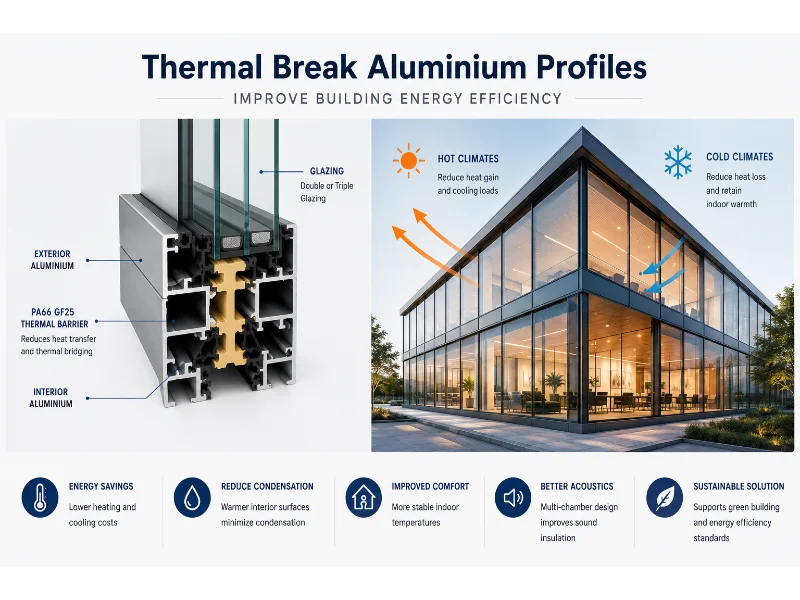
Thermal break aluminium profiles reduce heat transfer between indoor and outdoor environments, helping improve building energy efficiency and occupant comfort.
Reduced Heating Losses in Cold Climates
For projects in Germany, Canada, Northern Europe, and colder parts of North America, the focus shifts toward retaining indoor heat. By limiting thermal bridging, thermal break systems help maintain interior temperatures and reduce heating energy consumption throughout winter months.
More Stable Indoor Temperatures
Buildings with effective thermal barriers generally experience fewer temperature fluctuations. This reduces HVAC cycling frequency, improves occupant comfort, and may contribute to longer equipment service life.
Why Climate Matters When Selecting Thermal Break Profiles
The specification suitable for Riyadh may not be sufficient for Munich.
In hot climates, designers often prioritize:
- Solar heat reduction
- Cooling efficiency
- UV resistance
In colder climates, greater emphasis is placed on:
- U-value performance
- Condensation resistance
- Winter heat retention
As a result, projects in colder regions frequently require wider thermal barriers, multi-chamber profile designs, and higher-performance glazing systems. Understanding local climate requirements is essential when selecting profile specifications.
Additional Benefits Beyond Energy Savings
While energy efficiency is usually the primary reason for selecting thermal break systems, several secondary benefits are equally valuable.
Reduced Condensation Risk
The interior aluminium surface remains closer to room temperature, significantly reducing condensation formation.
Improved Occupant Comfort
Warmer interior frame temperatures eliminate the uncomfortable cold-surface effect often associated with conventional aluminium windows.
Better Acoustic Performance
Many thermal break systems incorporate multi-chamber designs that also improve sound insulation performance.
Common Applications of Thermal Break Aluminium Profiles
Thermal break systems are widely used across multiple building sectors.
Windows and Doors
Including:
- Casement windows
- Sliding windows
- Awning windows
- Aluminum Sliding doors
- Aluminum Folding doors
- Entrance door systems
Curtain Wall Systems
Both stick-built and unitized curtain wall systems rely heavily on thermal break technology to meet modern energy-efficiency standards.
Residential Buildings
- Villas
- Apartments
- High-end housing developments
Commercial and Public Buildings
- Office towers
- Hotels
- Shopping centers
- Hospitals
- Schools
- Government facilities
Specialty Applications
- Sunrooms
- Pergolas
- Louvers
- Cold-storage doors
- Balcony connection systems
What Buyers Often Overlook When Comparing Thermal Break Profiles
Many buyers compare thermal break profiles primarily based on price per kilogram. In practice, this can be misleading.
Two profiles may contain similar aluminium weight yet deliver very different thermal performance due to differences in:
- Polyamide strip width
- Multi-chamber design
- Thermal barrier quality
- Manufacturing precision
- Mechanical bonding strength
We have seen projects where a modest increase in profile cost resulted in substantial reductions in long-term HVAC expenses. For commercial buildings, lifecycle cost is often more important than initial material cost.
Specification Recommendations for Different Project Types
For standard residential windows, thermal break profiles using PA66 GF25 strips with wall thicknesses between 1.4 mm and 1.6 mm are generally sufficient. For larger openings, high-rise buildings, curtain wall systems, and premium architectural projects, profiles between 1.8 mm and 2.0 mm often provide a better balance between structural strength and thermal efficiency.
Before selecting a supplier, buyers should verify:
- Thermal barrier material
- Thermal barrier width
- Pull-out test performance
- Surface treatment quality
- Production consistency
- Relevant test reports
- Export and project support experience
In our experience, these factors have a far greater impact on long-term building performance than simply comparing aluminium profile prices.