16 Years Full Experience In Aluminum ProfilesDesign, mold opening, extrusion, deep processing, surface treatment
Inquiry
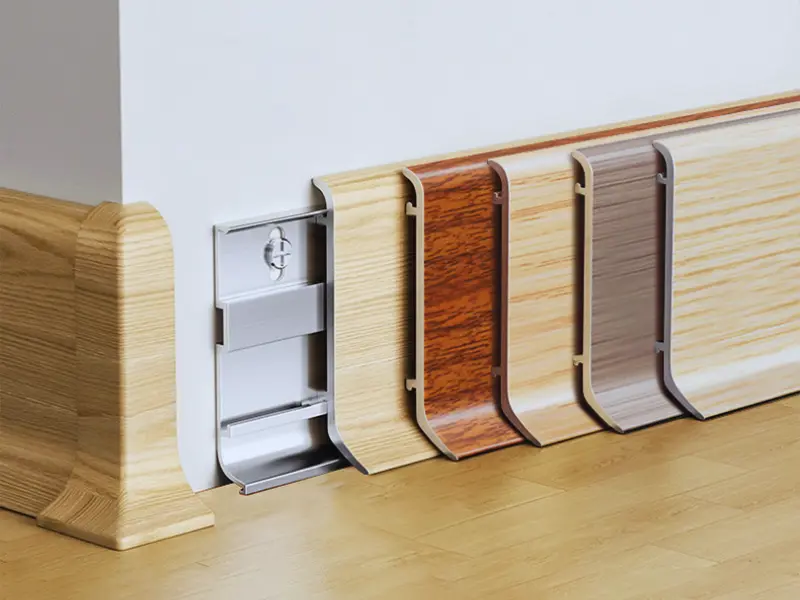
Clip-on aluminum skirting board with wood grain finish, multiple colors for home and commercial use
Aluminum Alloy Baseboards vs. PVC Baseboards
2026-05-25

The Dilemma of Choosing Baseboards Skirting boards, an often-overlooked architectural detail, actually serve a dual purpose: protecting the base of walls, concealing floor expansion joints, and providing a visual transition between spaces. In today’s decorative materials market, aluminum alloy and PVC skirting boards have become the two most popular choices, yet their positioning is starkly different—aluminum alloy represents durability, modernity, and high-tech sophistication, while PVC is known for its cost-effectiveness and ease of installation. For homeowners, contractors, commercial property managers, and even wholesale buyers, deciding between these two materials often involves a difficult trade-off between budget, design style, and service life. This guide provides a comprehensive comparison covering physical properties, aesthetic appeal, installation, life-cycle costs, and environmental attributes. It also highlights the irreplaceable value of aluminum alloy baseboards in the field of smart home integration, helping you make precise procurement decisions for your projects. I. Understanding Aluminum Alloy and PVC Baseboards 1.1 What Are Aluminum Alloy Baseboards? Aluminum alloy baseboards are manufactured by extruding aluminum profiles through molds, offering a variety of shapes and finishes. They typically require surface treatment...

Aluminum vs steel solid bars comparison. Left: bright silver aluminum rods; right: darker steel rods. Raw materials for construction and industrial applications.
Aluminum vs. Steel: How to Choose in 2026?
2026-05-18

Shenghai Global Aluminum has 16 years of experience in aluminum extrusion, CNC precision machining, and anodizing/powder coating. We have provided customized aluminum profile solutions for hundreds of overseas projects, including German door and window systems, U.S. solar mounting systems, Japanese heat sinks, and Australian building curtain walls. Drawing on real-world examples from our frontline production and customer service, this article systematically compares the key differences between aluminum and steel to help you quickly make the best material selection decision for your project. I. Aluminum vs. Steel: Key Performance Indicator Comparison and Material Selection Recommendations Comparison Criteria Aluminum Steel Shenghai Global’s 16-Year Experience Recommendation Density (g/cm³) 2.70 7.85 Need to reduce transportation and installation weight? Aluminum is about two-thirds lighter than steel, making it particularly suitable for high-altitude work and export shipping, which can save significant freight costs. Tensile Strength (MPa) 6061-T6: 3107075-T6: 572 Mild Carbon Steel: 400–500Alloy Steel: 700–2000+ Choose steel for heavy-duty load-bearing structures; choose aluminum for light-load, decorative, and heat-dissipation applications. For the vast majority of doors, windows, and solar panel mounts, 6063-T5 (strength approx. 200 MPa) is...

Performance comparison between coastal uPVC windows and aluminum casement windows with cross-section views
Aluminum Windows vs. uPVC Windows for Coastal Areas
2026-05-11

I. How should one choose between these two window and door materials for coastal areas? Aluminum alloy windows and doors are recommended because they offer high structural strength and excellent wind resistance. They can be paired with large glass panels, allowing rooms or living areas to enjoy beautiful ocean views. They are particularly suitable for seaside tourist areas and high-end residential projects. II. What are the primary weather conditions in coastal areas, and how do they affect the performance of windows and doors? Salt fog environment: Coastal areas are frequently exposed to sea breezes carrying large amounts of sodium chloride particles. These chloride ions react electrochemically with metal window and door frames, causing corrosion. Typical high-salt-fog regions include Dubai, Abu Dhabi, and Jeddah. Intense UV Radiation: At the coast, doors and windows are not only exposed to direct sunlight but also to UV radiation reflected off the water’s surface and clouds, resulting in total radiation levels far higher than in inland areas. This accelerates the aging of door and window materials, particularly uPVC, which tends to yellow and become brittle...

Three major aluminum surface treatments: Powder Coating (Vertical Line), Anodizing, and Electrophoretic Coating in a professional factory.
Selecting the Superior Finish for High-End Aluminum Hollow Sections
2026-05-08

I. Surface Treatment Is Not Just About “Appearance” In various applications—such as building components like doors, windows, and curtain walls; furniture including cabinets and wardrobes; and solar mounting brackets—aluminum hollow sections have long been a commonly used material. They offer numerous advantages, including durability, scratch resistance, and strength, and can be finished in attractive colors. These characteristics directly determine the product’s durability when exposed to salt spray, UV radiation, and acid rain, as well as the first impression it makes when touched by end users. Global climates vary widely: from the scorching 50°C sun of the UAE to Singapore’s year-round 85% humidity, and the salt corrosion from de-icing in Northern Europe. Choosing the wrong surface treatment can lead to fading, chalking, and peeling within two to three years—which is not only a quality issue but also a brand disaster. The following comparison of the three leading high-end surface treatment technologies will help you select the right one. II. Anodizing Why Choose Anodizing for Aluminum Hollow Sections? Anodizing is synonymous with a metallic finish and does not suffer from peeling or...

Side by side comparison of genuine thermal break aluminum window profile (left) vs fake non-thermal break aluminum profile (right), showing continuous polyamide thermal break strip for heat insulation
Thermal Break vs. Non-Thermal Break Aluminum: Price Analysis & ROI Case Studies
2026-04-27

I. Why This Issue Is More Important in 2026 Than Ever Before The global aluminum extrusion market is growing rapidly. Thermal break technology is facing unprecedented market opportunities in 2026. According to market research, the aluminum extrusion market is projected to grow at a compound annual growth rate (CAGR) of 9.5% from 2025 to 2030, reaching a value of $44.8 billion. The building and construction sector is one of the biggest drivers of this growth—thermal break aluminum profiles are becoming the standard rather than an option for meeting global green building codes. II. What is the difference between Thermal Break and Non‑Thermal Break? 2.1 What is a Thermal Break? A Thermal Break refers to the insertion of a low-thermal-conductivity insulating material (such as polyamide strips or polyurethane) between the inner and outer chambers of an aluminum profile. This physically interrupts the heat transfer path, effectively reducing heat loss through the metal. Thermal Break technology is the most widely used in aluminum doors, windows, and curtain walls, and is commonly found in everyday life. 2.2 What is a Non‑Thermal Break? A...

Aluminum mullion frame cross-section types for high-rise curtain wall systems, showing structural details, thermal breaks, and glass connections
How to Choose the Right Aluminum Mullion Frame for High-Rise Buildings
2026-04-20

Ensure structural safety with the right aluminum mullion frame. Learn about wall thickness, 6063-T6 specs, and global standards for high-rise curtain walls.

Full Range 6063 Aluminum Extrusion Profiles - Window Door, Trim Strip, Skirting, Curtain Track
Why Aluminum 6063 Is the Best Alloy for Architectural Profiles
2026-04-14

First and foremost, Aluminum 6063 presents a low degree of difficulty during extrusion processing, allowing for the effortless formation of a wide variety of complex architectural cross-sections. Secondly, its mechanical strength strikes an ideal balance—neither too soft nor too hard—enabling it to effectively withstand external impacts such as typhoons and physical collisions. Furthermore, its surface treatment processes are straightforward, yielding aesthetically pleasing finishes with exceptional durability; the resulting profiles exhibit excellent dimensional stability and are highly resistant to deformation. Finally, it offers the dual advantages of low production costs and a high recyclability rate. Technical Specifications & Properties of 6063 Alloy Category Property / Component Typical Value / Specification Chemical Composition Magnesium (Mg) 0.45% - 0.90% Silicon (Si) 0.20% - 0.60% Iron (Fe) ≤ 0.35% (Optimized for surface quality) Aluminum (Al) Balance (Approx. 97.5% - 99.4%) Physical Properties Density 2.69 - 2.70 g/cm³ Thermal Conductivity 201 - 218 W/(m·K) Mechanical Properties Tensile Strength 145 - 190 MPa (T5/T6) Yield Strength (T6) ≈ 140 MPa Key Characteristics Strengthening Phase Magnesium Silicide (Mg₂Si) Corrosion Resistance High (Low copper content) Why Is Aluminum...

Daylight view of an aluminum pergola with screens featuring detailed 6063-T6 aluminum extrusion profile cross-sections.
Why Your Pergola Shouldn't Wobble: The 6063-T6 Aluminum Specification Guide
2026-04-08

Hello. If you are asking what an Aluminum pergola with screens is, we must first achieve a civilized consensus: it is not "garden furniture." That is a term reserved for folding chairs and wobbly tables. In the realm of proper engineering, this is a Monolithic environmental envelope. Essentially, it is a "habitable outdoor precinct." It utilizes a skeleton of high-yield aluminum that refuses to succumb to entropy, paired with automated screens that seal with the precision of a mechanical zipper to exclude hexapods and gusts. It is not merely a sunshade; it is a precisely calibrated machine for sanctuary, ensuring you remain undisturbed by the elements. What are the advantages of an Aluminum pergola with screens compared to other pergolas? 1. Aluminum vs. Timber (The Refusal of Decay)Wood is, by its biological nature, a material in a state of permanent decay. In high-labor markets like Germany or Slovakia, choosing wood is a commitment to a lifetime of sanding and painting. Our system utilizes 6063-T6 structural aluminum, extruded by a 3600T press to achieve atomic-level density. This is "Fit and Forget"...

Modern high-rise interior featuring a Shenghai Global charcoal grey thermal break aluminum window system, with a technical inset showing the PA66GF25 green insulation core and multi-cavity extrusion profile.
Thermodynamic Logic and Engineering Standards of Thermal Break Aluminum Systems
2026-04-03

I. Why is a "Thermal Break" Design Essential for Aluminum Alloys? Aluminum alloy holds an exceptionally high status in the engineering world; however, it possesses a critical physical characteristic: a thermal conductivity of k ≈ 200 W/(m·K). This means it functions as an extraordinarily efficient "heat exchanger." In extreme climatic environments—such as the 50°C heatwaves of the Middle East or the high heat and humidity of Southeast Asia—non-thermal-break profiles constitute a structural defect. They relentlessly pump external thermal energy into the interior space. If you are still utilizing non-thermal-break profiles, you are not constructing a building; rather, you are fabricating a massive heat sink. At Shenghai Global, we view this as a fundamental design failure that attempts to fight the laws of thermodynamics with excessive HVAC power. From a thermodynamic standpoint, this approach is profoundly unsound. II. How is the PA66GF25 Thermal Break Strip Structurally Integrated with Aluminum Alloy? The construction process adheres to rigorous mechanical principles. Employing the "Rolling" method, the process begins by knurling the pre-cut grooves within the aluminum profile to enhance frictional grip. Subsequently, the PA66GF25...

Modern motorized bioclimatic aluminum pergola structure made of reinforced 6063-T6 hardened alloy from 3600T heavy-duty press.
How to Choose the Best Aluminum Pergola: 2026 Engineering & Buying Guide
2026-03-30

Expert 2026 guide on choosing aluminum pergolas. Audit 3600T extrusion, 6063-T6 alloy profiles, and 150kg/m2 snow loads. Ensure 25-year durability and high ROI.

Moderné hliníkové pergoly so sklenenou strechou na terasu. Vložený kruhový obrázok ukazuje rôzne hliníkové extrúzne profily.
2026 Architectural Audit: Why Industrial Aluminum Pergolas Outperform Conventional Systems
2026-03-26

Engineered for Slovakia’s 2026 weather. Shenghai’s 6063-T5 Hliníkové pergoly feature 3600T extrusion for zero-sway stability. Get the 15-year ROI audit today.

Homepage of Capral Aluminium Australia website, highlighting LocAl green aluminum extrusions and AGS commercial window systems.
Top 10 Aluminum Window & Door Suppliers in Australia 2026 (Expert Audit)
2026-03-23

The Australian aluminum window and door market is highly fragmented, with over 1,500 businesses operating nationwide. Navigating this landscape requires strict adherence to AS2047 compliance and demanding NatHERS energy efficiency ratings. Below is our 2026 expert audit of the top 10 most prominent suppliers—and a strategic look at how developers are optimizing their supply chains to bypass local retail markups. At a Glance: 2026 Top 10 Suppliers Comparison A quick-reference matrix of Australia's leading aluminum extrusion and window system providers, categorized by their business models and core market focus. Company HQ / Reach Business Model Key Specialties Primary Target Market 1. Capral Aluminium NSW / National Extruder & System Distributor LocAl® Green Aluminum, AGS Commercial High-rise Commercial & General Residential 2. Alspec 14 National Hubs System Designer & Distributor ProGlide® Doors, ThermAFrame® Architectural Commercial & High-end Residential 3. AWS 200+ Fabricator Network Bespoke System Designer Vantage®, Elevate™, ThermalHEART™ Architect-Specified Custom Homes 4. Bradnam's QLD / National Vertically Integrated Manufacturer Essential & Signature Tiers Volume Residential Builders & Retail 5. Dowell Windows VIC / National Large-Scale Manufacturer ThermaLine®, VisionLine® National Volume...

InquireInquire