
Evaluating Aluminum Tensile Strength for Industrial Components
Date: 2026-09-09Views: 314
Core Material Strength Metrics
Before comparing specific grades, it is helpful to understand exactly how strength is measured in industrial applications. We typically evaluate aluminum using two distinct thresholds measured in MegaPascals (MPa):
- Yield Strength: This is the practical limit for most structural designs. It indicates the exact amount of stress the aluminum can withstand before it permanently bends or deforms. Once the load is removed, the material will not return to its original shape.
- Ultimate Tensile Strength (UTS): This represents the absolute maximum pulling stress the material can endure before it completely fractures or snaps.
For safety-critical components in aerospace or heavy machinery, designers typically calculate loads based on yield strength while retaining a generous safety margin below the ultimate tensile strength.
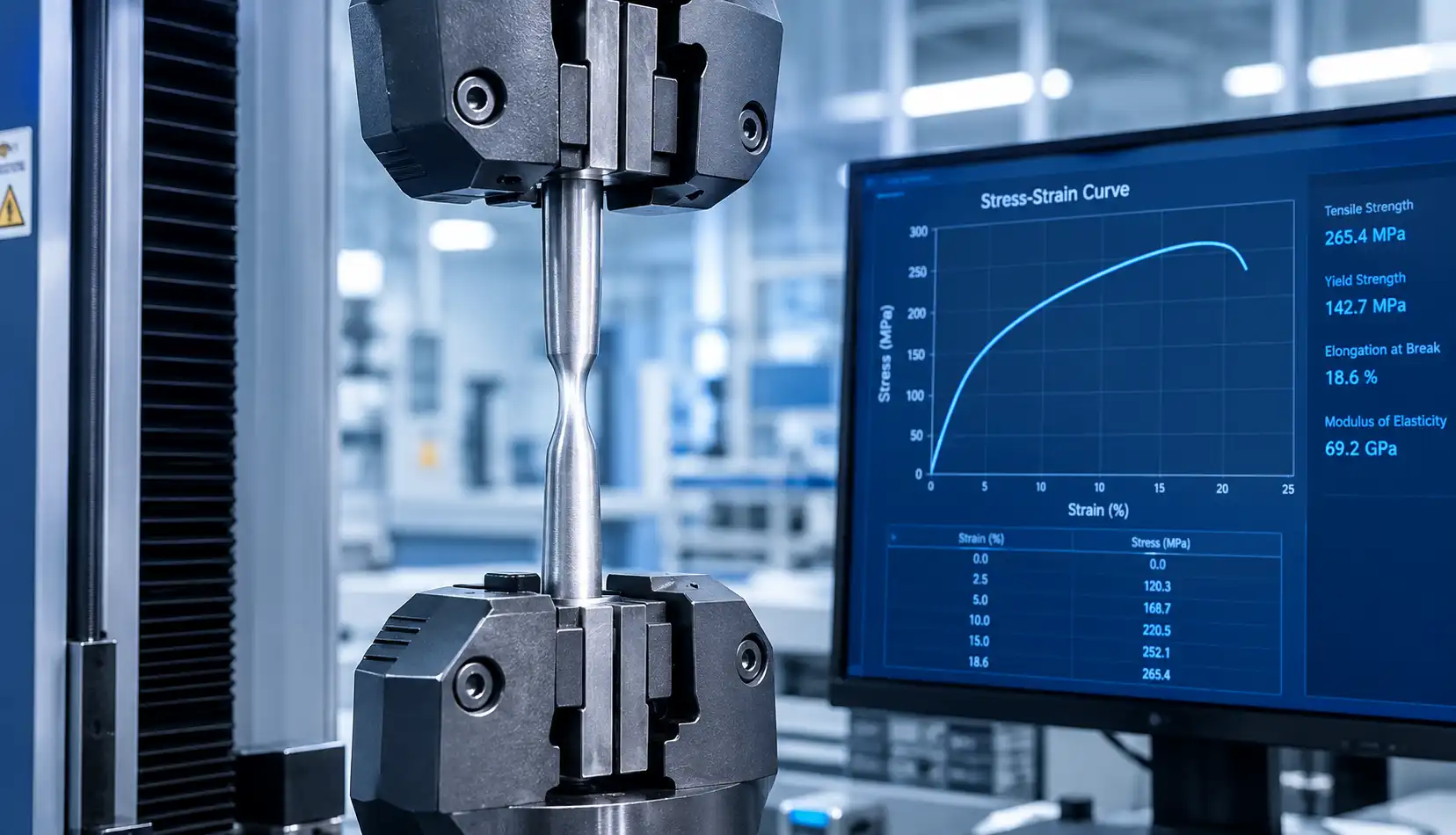
Testing the ultimate tensile strength (UTS) and elastic modulus of an extruded aluminum sample.
How Chemistry Defines Baseline Performance
Pure aluminum (the 1xxx series) is highly conductive and resistant to corrosion, but it lacks the rigidity required for mechanical components. By introducing specific alloying elements, manufacturers fundamentally alter the metal's crystalline structure.
- 6xxx Series: Blended with silicon and magnesium, this is the industry standard for general industrial frames, automotive parts, and architectural structures. It provides a balanced aluminum tensile strength and is highly receptive to forming processes.
- 7xxx Series: Blended with zinc, this series dominates when extreme load-bearing capacity is required. Grades like 7075 are heavily utilized in defense and aerospace manufacturing because their strength curves can exceed 500 MPa, delivering a strength-to-weight ratio superior to many heavy structural steels.
| Alloy Series | Primary Element | Typical Yield Strength | Ultimate Tensile Strength (UTS) | Extrudability | Typical Applications |
|---|---|---|---|---|---|
| 1xxx (Pure) | Pure Aluminum (99%+) | 30 - 60 MPa | 70 - 120 MPa | Very High | Electrical bus bars, chemical equipment linings |
| 6xxx (Structural) | Silicon (Si) + Magnesium (Mg) | 150 - 280 MPa | 190 - 350 MPa | High | Industrial automation frames, doors/windows, heat sinks |
| 7xxx (Aerospace) | Zinc (Zn) | 400 - 500+ MPa | 480 - 600+ MPa | Moderate | Aerospace structures, military, high-stress components |
* Source: ASM Aerospace Specification Metals and general industrial standards. Note: The mechanical properties listed are typical values for T6 temper where applicable.
The Impact of Manufacturing Processes on Strength
A common misconception in metal procurement is that the chemical alloy alone determines the final strength. In reality, the physical manufacturing method plays an equally important role.
Hot Extrusion: The Optimal Combination of Complex Design and High Strength
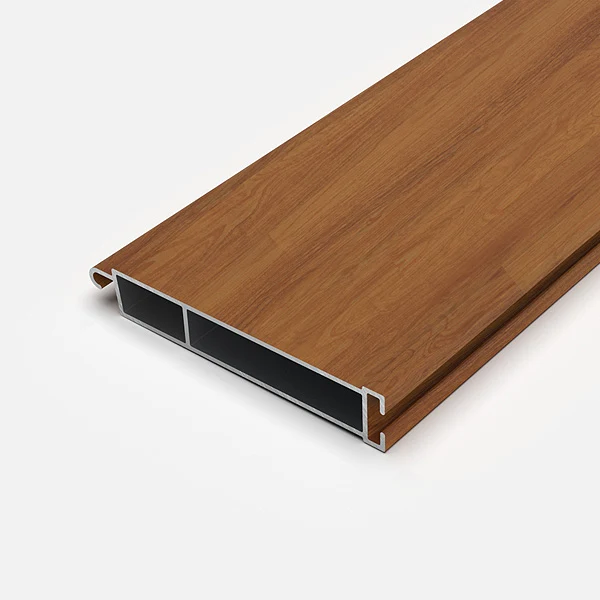
The true advantage of the extrusion process lies in its unrivaled shaping capability. Heated metal is forced through a die, allowing manufacturers to create extremely complex cross-sections, multi-cavity hollow profiles, and integrated T-slots in a single pass.
Although extrusion occurs at high temperatures, extruded parts rely on precise secondary thermal processes to achieve industrial-grade aluminum tensile strength. For example, the T6 temper (solution heat treatment followed by artificial aging) firmly locks the internal grain structure into a rigid state. This means that through extrusion, you can achieve both highly complex functional designs and exceptional mechanical strength—a combination difficult to match with other forming methods.
Specific Applications for Cold Drawing
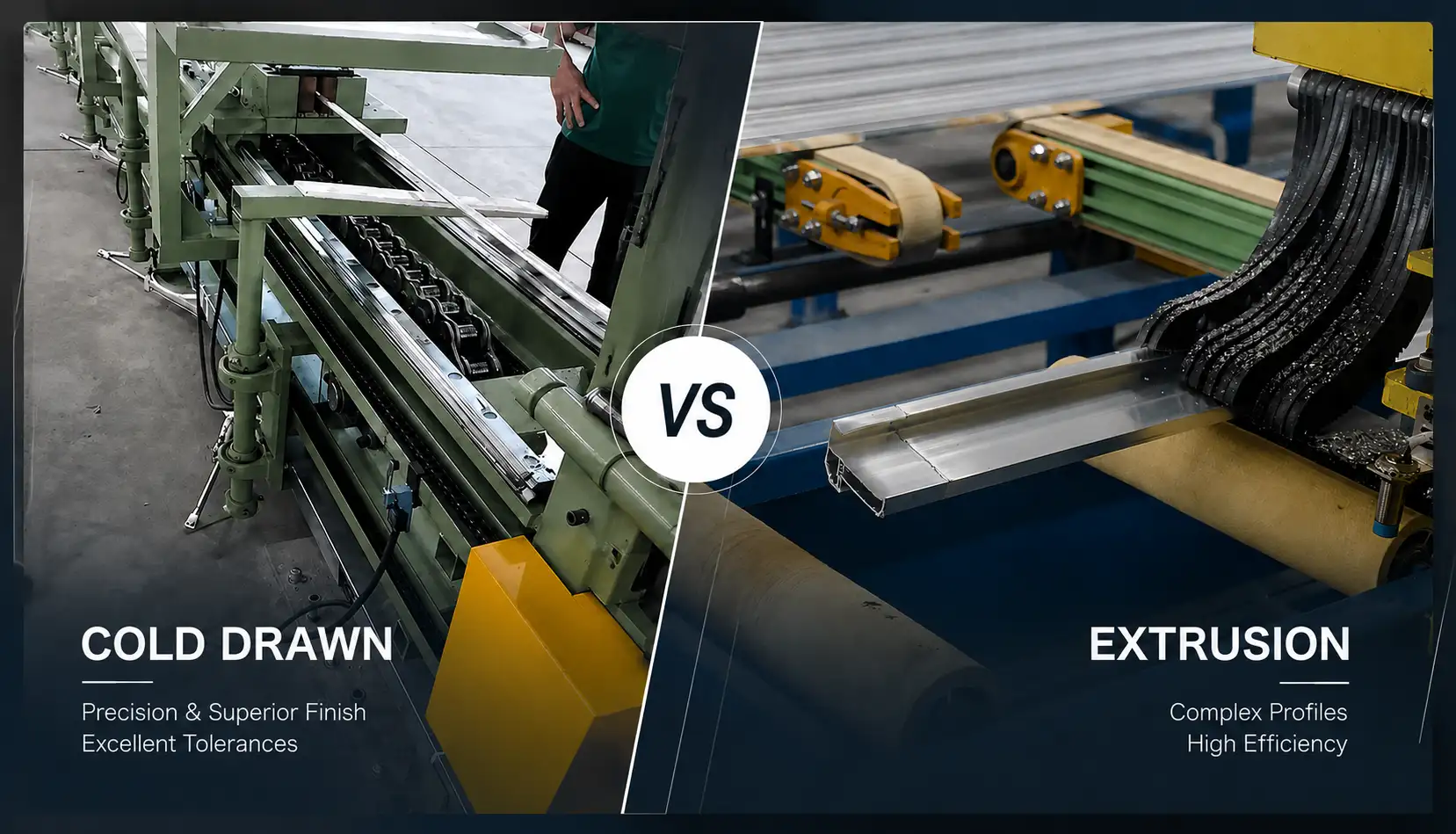
Cold drawing pulls the metal through a die at room temperature, utilizing strain hardening to increase strength and dimensional precision. However, its limitations lie in its flexibility and cost; it is generally restricted to simple, symmetrical tubes and rods, making it less versatile and more expensive to produce. Cold drawing serves as a suitable supplementary choice only for specific scenarios requiring extreme dimensional tolerances, such as high-pressure hydraulic tubing.
| Feature | Aluminum Extrusion + T6 Heat Treatment | Cold Drawing |
|---|---|---|
| Cross-Sectional Design Freedom | Very High (Custom multi-cavity, T-slots, and complex shapes) | Low (Limited to simple tubes, squares, or solid rods) |
| Strengthening Method | T6 Solution heat treatment & artificial aging | Physical strain hardening (Work hardening) |
| Overall Production Cost | Lower (Ideal for large-scale batch production) | Higher (High tooling wear, slower processing speed) |
| Functional Integration | High (Single-piece forming reduces downstream assembly and machining) | Low (Typically requires extensive secondary machining) |
Environmental Considerations
When specifying aluminum for outdoor or high-heat environments, procurement teams must account for thermal degradation. Aluminum tensile strength is not static; it begins to progressively decrease when exposed to continuous operating temperatures exceeding 150°C (300°F). If a component will face sustained high heat, engineers must over-engineer the initial strength requirements (leaving an ample safety margin) to prevent long-term material fatigue.
Making the Right Sourcing Decision
Specifying the right material is a comprehensive balance of structural performance, design freedom, and cost-efficiency. For the vast majority of industrial automation equipment, custom structural framing, and commercial applications, high-quality extruded aluminum profiles (combined with thermal treatments like T6) are undoubtedly the most advantageous choice.
The extrusion process not only provides the necessary aluminum tensile strength for high-stress environments but also allows multiple assembly functions to be integrated directly into a single profile through custom die tooling. This simplifies the supply chain and significantly reduces downstream machining and assembly costs. By selecting the right alloy grade and temper, extruded aluminum can serve as the most robust and flexible foundation for your project.