
Aluminum Alloy Thermal Conductivity: Engineering Data, Alloy Comparison & Heat Sink Design
Date: 2026-09-16Views: 508
In modern engineering design, thermal conductivity is one of the most important material properties when designing heat sinks, electronic housings, battery cooling components, heat exchangers, and other thermal-management systems.
Aluminum is widely used in these applications because it combines relatively high thermal conductivity with low density, good corrosion resistance, excellent machinability, and strong extrusion capability. However, “aluminum” does not have a single thermal conductivity value.
Depending on alloy composition, temper condition, microstructure, temperature, and processing history, the thermal conductivity of aluminum alloys can vary significantly. Commercially pure aluminum can reach more than 230 W/(m·K), while high-strength alloys such as 7075-T6 may be closer to 130 W/(m·K).
More importantly, thermal conductivity alone does not determine how effectively a finished component dissipates heat. Heat-sink geometry, contact resistance, surface area, airflow, surface emissivity, and the overall thermal path can be equally important.
This guide examines aluminum alloy thermal conductivity from both a materials and engineering-design perspective, including alloy comparison, 6061 vs 6063, thermal resistance calculations, microstructural effects, heat-sink geometry, testing methods, and practical alloy selection.
1. Aluminum Thermal Conductivity at a Glance
The following values provide a practical reference for commonly used aluminum grades at approximately room temperature.
| Aluminum Alloy | Temper | Typical Thermal Conductivity | Typical Applications |
|---|---|---|---|
| 1050 | O / H14 | ~220–230 W/(m·K) | Heat spreaders, electrical applications |
| 1060 | O / H14 | ~230 W/(m·K) | Electrical conductors, thermal components |
| 3003 | H14 | ~190 W/(m·K) | Heat exchangers, tubing, thermal-management components |
| 5052 | H32 | ~138 W/(m·K) | Enclosures, sheet-metal components |
| 6063 | T5 / T6 | ~190–200 W/(m·K) | Extruded heat sinks, architectural profiles |
| 6061 | T6 | ~167 W/(m·K) | CNC-machined components, structural thermal parts |
| 7075 | T6 | ~130 W/(m·K) | Aerospace and high-strength components |
Source: The Aluminum Association & ASM International.
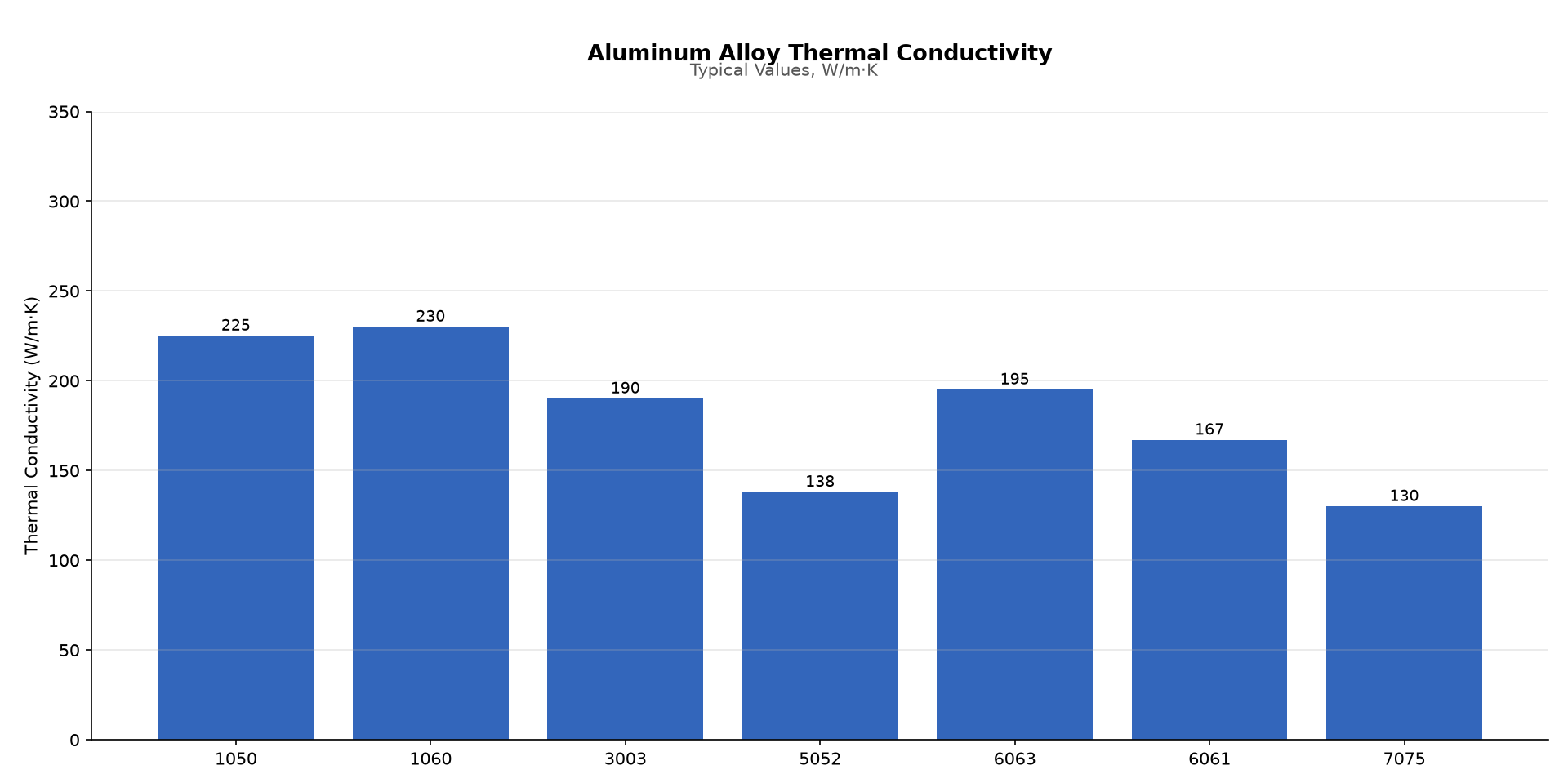
aluminum-alloy-thermal-conductivity-chart
These figures should be treated as engineering reference values rather than universal constants. Actual thermal conductivity can vary according to alloy chemistry, temper, product form, processing history, temperature, and measurement method.
For production-critical thermal applications, engineers should use the thermal-property data applicable to the exact material specification and condition being purchased or tested.
2. What Is Thermal Conductivity?
Thermal conductivity, represented by k, describes how readily heat moves through a material when a temperature gradient exists.
For one-dimensional steady-state conduction, Fourier's law can be expressed as:
Q = -kA (ΔT / Δx)
Where:
- Q = heat-transfer rate (W)
- k = thermal conductivity (W/(m·K))
- A = cross-sectional area perpendicular to heat flow (m²)
- ΔT = temperature difference (K)
- Δx = heat-flow distance (m)
The negative sign indicates that heat flows from a higher-temperature region toward a lower-temperature region.
For metals, heat is transported primarily by conduction electrons, while lattice vibrations also contribute. In highly conductive metals such as copper and aluminum, electron transport is particularly important.
The Wiedemann–Franz relationship helps explain why electrical and thermal conductivity are often correlated in metals:
k = LσT
where:
- k = thermal conductivity
- L = Lorenz number
- σ = electrical conductivity
- T = absolute temperature
However, real engineering alloys do not behave like perfectly pure metals. Alloying elements, impurities, precipitates, defects, and microstructure can increase electron scattering and reduce thermal transport.
3. Aluminum Alloy Thermal Conductivity by Alloy Series
Aluminum alloy series are differentiated primarily by their alloying systems, and those additions affect not only mechanical properties but also thermal and electrical transport.
| Alloy Series | Representative Grade | Major Alloying Elements | Typical Thermal Conductivity | Engineering Characteristics |
|---|---|---|---|---|
| 1000 Series | 1050 / 1060 | Very high aluminum content | ~220–237 W/(m·K) | Excellent conductivity, low strength |
| 3000 Series | 3003 | Mn | ~190 W/(m·K) | Good formability and corrosion resistance |
| 5000 Series | 5052 | Mg | ~138 W/(m·K) | Good corrosion resistance and formability |
| 6000 Series | 6063 | Mg, Si | ~190–200 W/(m·K) | Excellent extrusion characteristics |
| 6000 Series | 6061 | Mg, Si | ~167 W/(m·K) | Higher strength and excellent machinability |
| 7000 Series | 7075 | Zn, Mg, Cu | ~130 W/(m·K) | Very high strength, lower thermal conductivity |
Source: The Aluminum Association & ASM International.
The general trend is straightforward: increasing alloying content often reduces the thermal conductivity of aluminum, although the actual result depends on the specific alloy system and microstructure.
This is one reason why commercially pure aluminum can conduct heat much more effectively than many high-strength aerospace alloys.
4. Aluminum vs Copper vs Steel: Thermal Conductivity and Weight
Aluminum is rarely selected based on thermal conductivity alone. Density, strength, cost, corrosion resistance, manufacturability, and component geometry also influence material selection.
| Material | Thermal Conductivity @ ~25°C | Density | Engineering Consideration |
|---|---|---|---|
| Silver | ~429 W/(m·K) | 10.49 g/cm³ | Exceptional conductivity but very high cost |
| Copper C11000 | ~388 W/(m·K) | 8.96 g/cm³ | Excellent thermal performance but heavy |
| Pure Aluminum | ~237 W/(m·K) | 2.70 g/cm³ | High conductivity with very low density |
| 6061-T6 Aluminum | ~167 W/(m·K) | 2.70 g/cm³ | Strong balance of strength, weight and conductivity |
| Brass | ~109 W/(m·K) | 8.73 g/cm³ | Moderate conductivity and good machinability |
| Carbon Steel | ~51 W/(m·K) | 7.87 g/cm³ | Primarily selected for strength and cost |
| 304 Stainless Steel | ~16 W/(m·K) | 8.00 g/cm³ | Excellent corrosion resistance but poor thermal conductivity |
Source: Engineering ToolBox.
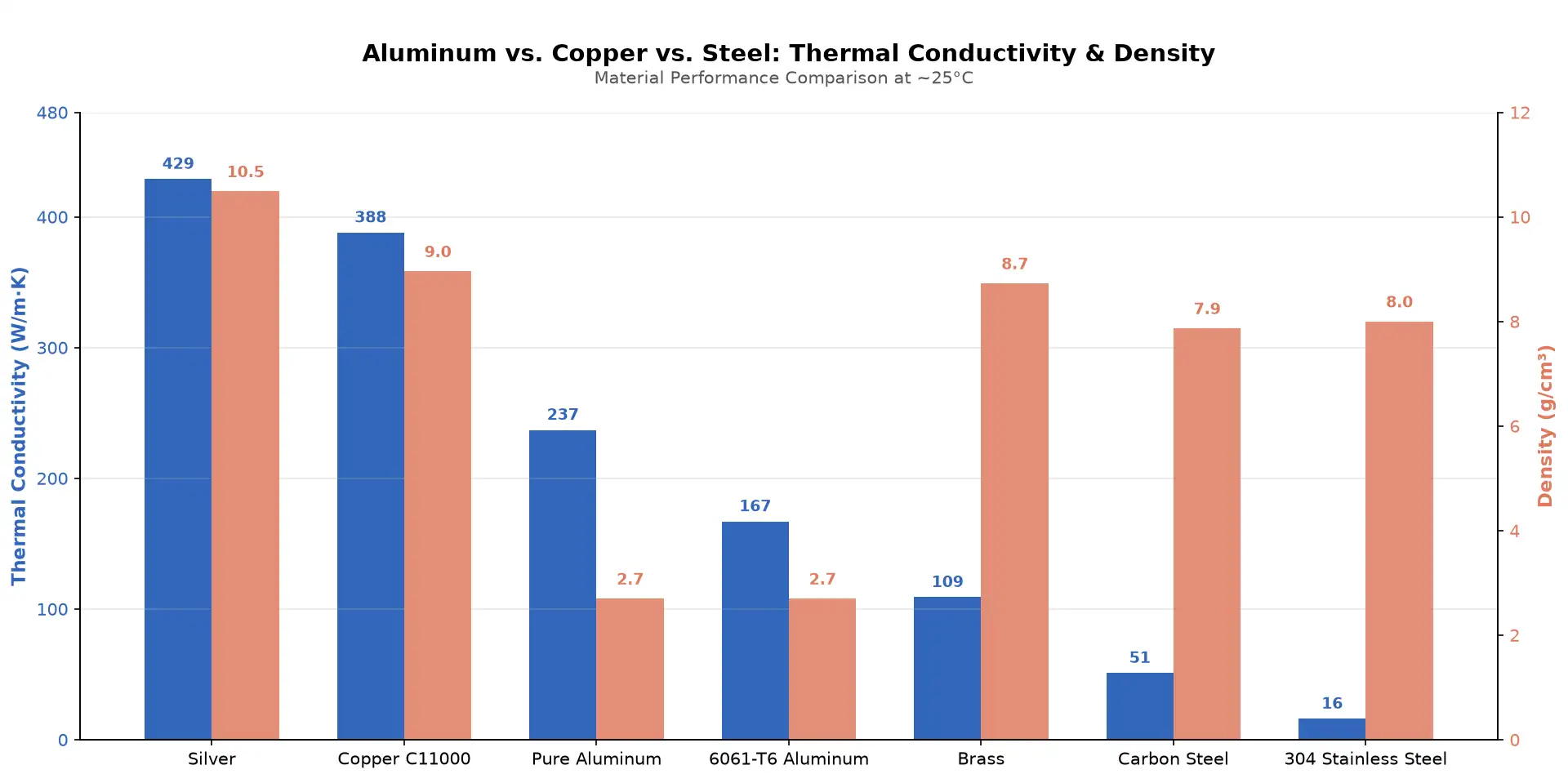
Performance comparison chart illustrating the balance between thermal conductivity (W/m·K) and density (g/cm³) for aluminum, copper, brass, and steel grades at ~25°C.
Copper can provide more than twice the thermal conductivity of many aluminum alloys, but it is also more than three times as dense.
For large heat sinks, housings, extrusion profiles, and structural thermal components, aluminum's low density can be a major advantage.
The engineering question is therefore not simply:
Which material has the highest thermal conductivity?
It is often:
Which material provides the required thermal performance at an acceptable weight, cost, strength, and manufacturing complexity?
5. 6061 vs 6063: Which Aluminum Alloy Is Better for Heat Dissipation?
6061 and 6063 are both widely used 6000-series aluminum alloys, but they are optimized for somewhat different requirements.
| Property | 6061-T6 | 6063-T5/T6 |
|---|---|---|
| Thermal conductivity | ~167 W/(m·K) | ~190–200 W/(m·K) |
| Mechanical strength | Higher | Lower |
| Extrudability | Good | Excellent |
| Complex profiles | Good | Excellent |
| Thin heat-sink fins | Good | Excellent |
| CNC machining | Excellent | Good |
| Structural applications | Excellent | Moderate |
| Heat-sink extrusion | Good | Excellent |
Source: The Aluminum Association & ASM International.
For a complex extruded heat sink, 6063 is often attractive because it combines relatively high thermal conductivity with excellent extrusion characteristics.
Its ability to produce thin walls, narrow channels, and high-aspect-ratio fins makes it particularly suitable for passive cooling and forced-air heat sinks.
6061-T6, on the other hand, is often preferred when mechanical strength, CNC machining, dimensional stability, and structural performance are more important.
Therefore:
- Choose 6063 when extrusion geometry and thermal performance are major priorities.
- Choose 6061 when strength, machining, and structural performance are more important.
Neither alloy is universally “better.” The correct choice depends on the thermal path and mechanical requirements of the finished component.
6. Thermal Conductivity vs Thermal Diffusivity
Thermal conductivity is often confused with thermal diffusivity, but they describe different aspects of thermal behavior.
Thermal diffusivity is defined as:
α = k / (ρCp)
Where:
- α = thermal diffusivity (m²/s)
- k = thermal conductivity (W/(m·K))
- ρ = density (kg/m³)
- Cp = specific heat capacity (J/(kg·K))
Thermal conductivity describes how effectively a material conducts heat.
Thermal diffusivity describes how quickly a temperature change propagates through the material.
This distinction is particularly important in transient thermal applications.
For example, two materials can have different densities and heat capacities even if their thermal conductivities are relatively similar. Their thermal diffusivities can therefore be substantially different.
This is also why techniques such as Laser Flash Analysis typically measure thermal diffusivity first and then calculate thermal conductivity using density and specific heat data.
7. Why Aluminum Alloy Thermal Conductivity Changes
Thermal conductivity is affected by more than nominal alloy designation.
Several microscopic mechanisms contribute to changes in thermal transport.
7.1 Alloying Elements and Solid-Solution Scattering
In aluminum, conduction electrons carry a significant portion of the heat.
When alloying atoms are dissolved within the aluminum matrix, they disturb the local electronic and atomic structure. This increases electron scattering and generally reduces thermal conductivity.
The effect varies substantially between alloying elements and their concentrations.
For this reason, high-purity aluminum can have considerably higher conductivity than heavily alloyed high-strength aluminum.
7.2 Precipitates and Heat Treatment
Heat treatment can change the distribution of alloying elements between the aluminum matrix and precipitated phases.
The resulting thermal conductivity depends on the alloy system, precipitate structure, aging condition, and amount of alloying elements remaining in solid solution.
Therefore, temper designation should not automatically be interpreted as a fixed thermal-conductivity value.
For engineering work, the thermal-property data corresponding to the actual temper and product condition should be used whenever available.
7.3 Trace Transition Elements
Small concentrations of certain transition elements can have a disproportionately large effect on aluminum's thermal and electrical conductivity.
Research on aluminum solid solutions has reported conductivity-reduction trends in which elements such as chromium and vanadium can produce strong scattering effects.
A commonly reported qualitative order is:
Cr > V > Mn > Ti > Zr > Si > Mg > Cu > Zn
This does not mean that every alloy containing chromium will automatically have lower conductivity than every alloy containing silicon. The actual effect depends on concentration, base composition, microstructure, and processing history.
For high-performance thermal materials, controlling melt chemistry and impurity levels can therefore be important.
8. Casting Microstructure and Thermal Conductivity
Cast aluminum alloys introduce another layer of complexity.
Alloys such as A356 and 319 contain significant amounts of silicon, and their thermal behavior depends not only on nominal chemical composition but also on the morphology and distribution of the silicon-containing phases.
Casting conditions can influence:
- Eutectic silicon morphology
- Porosity
- Grain structure
- Intermetallic phases
- Cooling rate
- Heat-treatment response
For example, modification treatments can alter the morphology of eutectic silicon. The effect on thermal and electrical conductivity depends on alloy chemistry, modifier concentration, cooling conditions, and resulting microstructure.
Porosity is also important because internal voids interrupt the conductive path and can increase the effective thermal resistance of a cast component.
This is a useful distinction:
The intrinsic conductivity of an alloy and the effective thermal performance of a manufactured component are not always the same.
9. Thermal Conductivity Does Not Equal Heat Dissipation
One of the most important concepts in thermal engineering is that higher thermal conductivity does not automatically mean better cooling.
A simplified conduction resistance can be written as:
Rcond = L / (kA)
And the temperature difference across that thermal resistance is:
ΔT = Q × Rcond
where:
- Rcond = conduction thermal resistance (K/W)
- L = heat-flow distance
- k = thermal conductivity
- A = heat-transfer cross-sectional area
- Q = heat-transfer rate
Consider two heat sinks made from aluminum alloys with slightly different thermal conductivity.
If one design has:
- thicker fins,
- better airflow,
- greater surface area,
- lower contact resistance,
- better base geometry,
it may outperform a material with a higher bulk thermal conductivity.
The complete thermal path is more important than the material property alone.
A simplified thermal system can be viewed as:
Heat Source → Interface → Aluminum Base → Fins → Air → Environment
Every stage contributes thermal resistance.
10. Why Heat-Sink Geometry Matters
For extruded aluminum heat sinks, geometry can have a major effect on practical cooling performance.
Important design variables include:
Fin Height
Higher fins can increase surface area, but excessively tall fins may become less effective because of airflow limitations and temperature gradients.
Fin Thickness
Thinner fins can increase the number of fins and total surface area, but they also require suitable extrusion capability and may become mechanically fragile.
Fin Spacing
Closely spaced fins provide more surface area but can restrict airflow, especially under natural convection.
Base Thickness
The base must spread heat effectively from the heat source into the fin structure.
Fin Density
Higher fin density is not always better. The optimum value depends on whether the system uses natural convection or forced airflow.
Airflow
A heat sink designed for a fan can use a different fin arrangement from one designed for natural convection.
Therefore, the optimal aluminum alloy and the optimal heat-sink geometry should be considered together.
11. Temperature Effects on Aluminum Thermal Conductivity
Thermal conductivity is temperature-dependent.
Published data for aluminum alloys can show significant changes across temperature ranges, particularly when moving toward cryogenic or elevated-temperature conditions.
For common engineering applications near room temperature, using a representative room-temperature value is often adequate for preliminary material selection.
However, for:
- high-temperature electronics,
- aerospace thermal systems,
- cryogenic equipment,
- battery thermal management,
- high-power electronics,
temperature-dependent material-property data should be used.
Engineers should therefore avoid treating a value such as 167 W/(m·K) for 6061-T6 as a universal constant across every operating condition.
12. Does Anodizing Reduce Aluminum Thermal Performance?
Anodizing creates an oxide layer on the aluminum surface.
Because the anodized layer is generally thin compared with the bulk aluminum substrate, its contribution to through-thickness conduction is often small compared with the thermal resistance of the overall component.
However, anodizing can have an important effect on surface emissivity.
This matters in applications where radiation contributes significantly to heat transfer.
A black anodized surface generally has substantially higher emissivity than a bright metallic surface, which can increase radiative heat transfer under appropriate operating conditions.
Therefore, anodizing should not simply be described as either “good” or “bad” for thermal performance.
Its effect depends on whether the dominant heat-transfer mechanism is:
- conduction,
- convection,
- radiation,
- or a combination of all three.
13. Industrial Applications of Aluminum Thermal Conductivity
13.1 High-Power Electronics and Communication Equipment
5G communication equipment, power electronics, industrial controllers, and electronic enclosures can generate substantial heat.
Aluminum housings and heat sinks provide:
- lightweight construction,
- effective heat spreading,
- corrosion resistance,
- good machinability,
- compatibility with extrusion and CNC manufacturing.
6061 and 6063 are both widely applicable depending on structural and extrusion requirements.
13.2 New Energy Vehicle Battery Thermal Management
Battery systems require controlled temperature distribution across cells and modules.
Aluminum alloys are commonly used in:
- cooling plates,
- heat exchangers,
- battery housings,
- structural thermal components.
3003 is widely used in heat-exchanger applications because of its combination of thermal performance, formability, and corrosion resistance.
In battery systems, however, thermal conductivity is only one design parameter. Coolant flow, contact resistance, plate thickness, channel geometry, and temperature uniformity are also critical.
13.3 Electric Motor Housings
Aluminum motor housings can combine lightweight construction with effective heat transfer from the motor windings toward the surrounding environment.
Cast alloys such as A356 may be used where casting complexity and structural requirements are important.
In these components, porosity and casting quality can influence the effective thermal performance of the final housing.
13.4 LED Heat Sinks
6063 aluminum is particularly attractive for extruded LED heat sinks because of its excellent extrusion characteristics.
Complex fin structures can be produced economically while maintaining relatively high thermal conductivity.
The final cooling performance depends on both:
6063 material properties + fin geometry + airflow + surface condition
rather than material conductivity alone.
13.5 Photovoltaic Inverters and Power Electronics
Power semiconductor devices such as IGBTs and other switching components generate substantial heat.
Aluminum heat sinks and thermal-management profiles can be combined with:
- forced-air cooling,
- liquid cooling,
- thermal interface materials,
- optimized fin structures.
The aluminum profile serves as part of the complete thermal path rather than acting as an isolated heat-transfer material.
13.6 Consumer Electronics and Portable Computing
Aluminum frames, housings, spreader plates, and structural components can help distribute localized heat over a larger area.
In high-performance laptops and compact electronic devices, aluminum components may work together with:
- vapor chambers,
- heat pipes,
- thermal interface materials,
- graphite spreaders,
- forced-air cooling.
This illustrates another important principle:
A high-conductivity aluminum component is often one part of a larger thermal-management architecture.
14. Engineering Example: Calculating Aluminum Thermal Resistance
Consider a simplified aluminum base used to conduct heat away from a component.
Assume:
- Aluminum alloy: 6061-T6
- Thermal conductivity: 167 W/(m·K)
- Heat-transfer area: 50 × 50 mm
- Base thickness: 8 mm
- Heat load: 100 W
First convert the dimensions:
A = 0.05 × 0.05 = 0.0025 m2
L = 0.008 m
The approximate conduction resistance is:
Rcond = 0.008 / (167 × 0.0025)
Rcond ≈ 0.0192 K/W
For a 100 W heat load:
ΔT = 100 × 0.0192
ΔT ≈ 1.92°C
This simplified calculation suggests that the aluminum base itself produces only a small temperature difference under ideal one-dimensional conduction.
However, this does not mean the entire heat sink will operate only 1.92°C above the heat source.
The actual thermal system also includes:
- thermal interface resistance,
- spreading resistance,
- fin-to-air convection,
- airflow resistance,
- radiation,
- contact resistance,
- heat-sink geometry.
This is why real thermal design cannot rely on bulk conductivity alone.
15. Thermal Conductivity Testing Methods
Thermal conductivity is measured using several different techniques depending on material type, geometry, conductivity range, and temperature.
| Method Category | Common Techniques | Typical Applications | Main Consideration |
|---|---|---|---|
| Steady-State | Guarded Hot Plate, ASTM C177 / ISO 8302 | Insulation, polymers, ceramics | Requires stable thermal equilibrium |
| Comparative / Heat Flow | ASTM E1225 | Solid materials | Suitable for controlled laboratory measurements |
| Transient | Laser Flash, ASTM E1461 | Metals, ceramics, composites | Measures diffusivity; conductivity is derived using density and specific heat |
| Transient Plane Source | TPS | Solids and selected other materials | Rapid measurement with small specimens |
| Micro/Nanoscale | 3ω, TDTR | Thin films and microelectronics | Specialized equipment and sample preparation |
Laser Flash Analysis
Laser Flash Analysis is particularly relevant to metals and other thermally conductive materials.
The technique measures thermal diffusivity, which can then be related to thermal conductivity through:
k = αρCp
Therefore, reliable values for density and specific heat are required when calculating conductivity.
16. How to Select an Aluminum Alloy for Thermal Management
There is no single aluminum alloy that is optimal for every thermal application.