


Thermodynamic Logic and Engineering Standards of Thermal Break Aluminum Systems
Date: 2026-04-03Views: 47
I. Why is a "Thermal Break" Design Essential for Aluminum Alloys?
Aluminum alloy holds an exceptionally high status in the engineering world; however, it possesses a critical physical characteristic: a thermal conductivity of k ≈ 200 W/(m·K). This means it functions as an extraordinarily efficient "heat exchanger."
In extreme climatic environments—such as the 50°C heatwaves of the Middle East or the high heat and humidity of Southeast Asia—non-thermal-break profiles constitute a structural defect. They relentlessly pump external thermal energy into the interior space.
If you are still utilizing non-thermal-break profiles, you are not constructing a building; rather, you are fabricating a massive heat sink. At Shenghai Global, we view this as a fundamental design failure that attempts to fight the laws of thermodynamics with excessive HVAC power. From a thermodynamic standpoint, this approach is profoundly unsound.
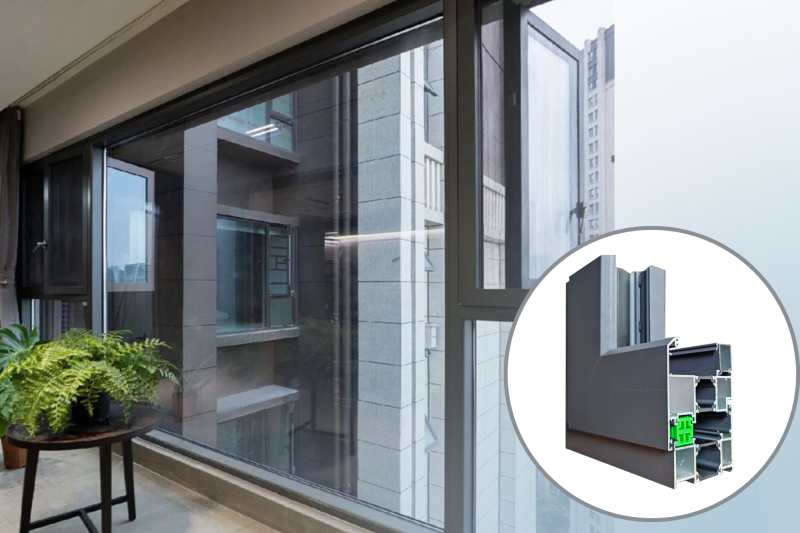
II. How is the PA66GF25 Thermal Break Strip Structurally Integrated with Aluminum Alloy?
The construction process adheres to rigorous mechanical principles. Employing the "Rolling" method, the process begins by knurling the pre-cut grooves within the aluminum profile to enhance frictional grip. Subsequently, the PA66GF25 thermal break strip is inserted; precision pressure rollers are then applied to the edges of the aluminum profile, inducing plastic deformation that creates a firm, interlocking grip.
The very soul of a Thermal Break System lies in that physical barrier layer. Shenghai Global insists on exclusively utilizing PA66GF25 (Polyamide 66 reinforced with 25% glass fiber).
Why is PA66GF25 the Irreplaceable Choice?
PA66GF25 enables the strip's coefficient of linear expansion to achieve "atomic-level synchronization" with aluminum (2.3 × 10⁻⁵/K). Within the rigorous logic of engineering, only a material that matches the hardness of 6063-T6 Aluminum Alloy can ensure that the system's tolerances remain firmly on track—within the range of ± 0.03mm—even after 30 years of structural load.
Warning: Risk of Non-Compliance
If you choose to use PVC thermal break strips merely to save a small amount on your budget, I can only wish you luck in finding some twisted amusement amidst the system loosening and air leakage failures that will inevitably occur. PVC belongs in cheap toys, not in Shenghai Global's rigorous architectural structures.
III. Our Thermal-Break Aluminum Doors and Windows Must Adhere to Strict Requirements.
All structural integrity begins at the extrusion press. At Shenghai Global, the output from our 3600-ton heavy-duty extrusion press consists of precision-engineered components, not mere profiles. We strictly adhere to the 6063-T6 temper, ensuring an atomically dense balance between mechanical strength and suitability for surface treatment.
- Wall Thickness Tolerance: Whether complying with GB/T 8478 or ASTM standards, we pursue a limit deviation of ± 0.03mm.
- Specification Auditing: For high-rise buildings, a 1.4mm wall thickness is merely the passing grade; 2.0mm is the correct specification required to withstand extreme wind pressure loads.
V. Is Surface Treatment for Aluminum Doors and Windows Really That Important?
Throughout the lifecycle of aluminum, environmental corrosion remains a perpetual adversary. Whether in the abrasive sandy environments of the Middle East or the high-salinity coastal zones of Malaysia, the Anodizing Surface Treatment determines the magnitude of your future maintenance costs.
- Class 2 Standard: We mandate a 25μm anodized coating layer.
- Physical Barrier: Through a dual-stage pore-sealing process, we effectively block the pathways for chloride ion penetration. If you believe a 10-micron oxide layer is sufficient, you are effectively inviting corrosion to dismantle your building's facade within five years.