
Why Your Pergola Shouldn't Wobble: The 6063-T6 Aluminum Specification Guide
Date: 2026-04-08Views: 11
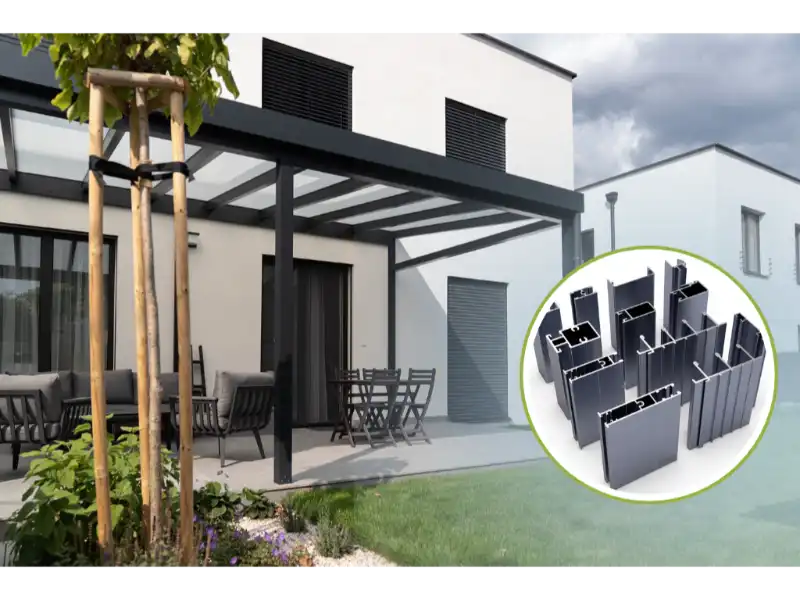
Essentially, it is a "habitable outdoor precinct." It utilizes a skeleton of high-yield aluminum that refuses to succumb to entropy, paired with automated screens that seal with the precision of a mechanical zipper to exclude hexapods and gusts. It is not merely a sunshade; it is a precisely calibrated machine for sanctuary, ensuring you remain undisturbed by the elements.
What are the advantages of an Aluminum pergola with screens compared to other pergolas?
1. Aluminum vs. Timber (The Refusal of Decay)
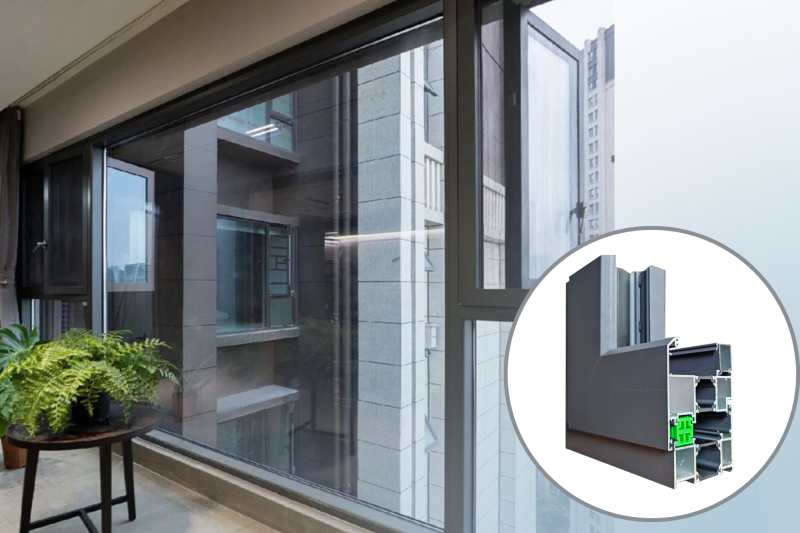
Wood is, by its biological nature, a material in a state of permanent decay. In high-labor markets like Germany or Slovakia, choosing wood is a commitment to a lifetime of sanding and painting. Our system utilizes 6063-T6 structural aluminum, extruded by a 3600T press to achieve atomic-level density. This is "Fit and Forget" engineering, ensuring the structure maintains its linear rigidity even under the crushing snow loads of Central Europe.
2. Aluminum vs. Vinyl (The Defeat of UV Degradation)
Vinyl (PVC) is a tempting shortcut for the budget-conscious, but it is physically incapable of withstanding environmental cycles. In the high-UV environments of Australia or the Southern United States, polymer chains break down, leading to yellowing and structural brittleness. A correctly specified aluminum system provides thermal stability and, when paired with a ZIP mechanical lock, offers a degree of sub-millimeter defensive precision that plastic simply cannot mimic.
3. Aluminum vs. Steel (The End of Oxidation)
Steel has strength, but its oxidation—rust—is an irreversible tragedy. In coastal regions like Dubai or Greece, salt ions will breach standard coatings and dismantle steel at a molecular level. Our aluminum systems employ a 25μm marine-grade anodizing standard. This creates a robust oxide barrier that blocks chloride penetration, ensuring metallurgical stability where steel would simply crumble.
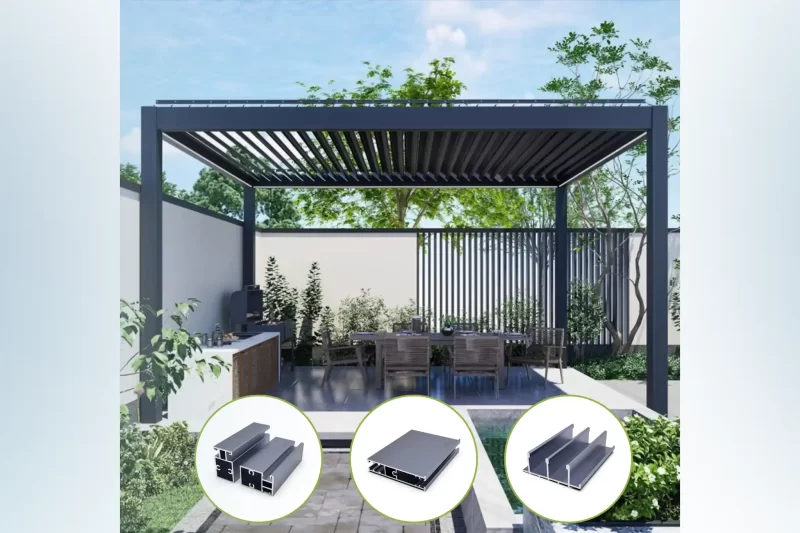
This monolithic environmental envelope utilizes 6063-T6 alloy profiles, extruded via a 3600T press to ensure structural certainty and linear rigidity under variable loads.
What types of Aluminum pergolas with screens are available?
1. Drive Methods
- Manual: Operated via a crank handle. It is cost-effective, requires no electrical intervention, and is mechanically simple—meaning it is virtually impossible to break.
- Motorized: Effortless operation via remote. These systems can be fitted with sensors that automatically retract the screens when gusts exceed 80km/h to prevent mechanical failure.
2. How to Mount Roller Blinds on a Frame (Fitting Styles)
- Integrated ZIP: The tracks are entirely recessed within the columns. It is architecturally flush and provides a hermetic seal against biological invaders.
- Surface-Mounted: Affixed to the exterior of an existing frame. While the tracks are visible, it is the fastest method for upgrading a legacy structure.
- Fixed: Stationary screens. Economical, but you forfeit the ability to retract the envelope at will.
3. Screen Material Choices
- Bug Mesh: A fine-gauge weave designed to thwart insects while permitting the movement of air.
- Sun Shields: High-density textiles for those who prefer not to be roasted. Essential for the Middle East or Australia.
- Privacy Blinds: Utilizes a one-way visual logic. You can observe the neighbors, but they cannot observe you.
- Weather-Resistant: Reinforced with fiberglass to withstand high-velocity rain without deforming.
What materials can be used for the framework of an aluminum pergola?
1. The Structural Core
- 6063-T5/T6 Architectural Grade Aluminum: The industry standard. T5 is the baseline, but 6063-T6 undergoes artificial aging for superior hardness. For large-span structures, T6 is the only logical choice.
- 6061-T6 Aircraft Grade Aluminum: The "Gold Standard" of alloys. It provides aircraft-wing rigidity for those who demand absolute structural integrity.
2. Aesthetic & Hybrid Options
- Wood-Grain/Vinyl Wrap: A clever bit of "visual deception." It offers the warmth of timber with the metallurgical refusal to rot.
- Steel-Aluminum Hybrid: Used in heavy industrial projects where a steel core provides load-bearing capacity, shielded by an aluminum exterior to prevent oxidation.
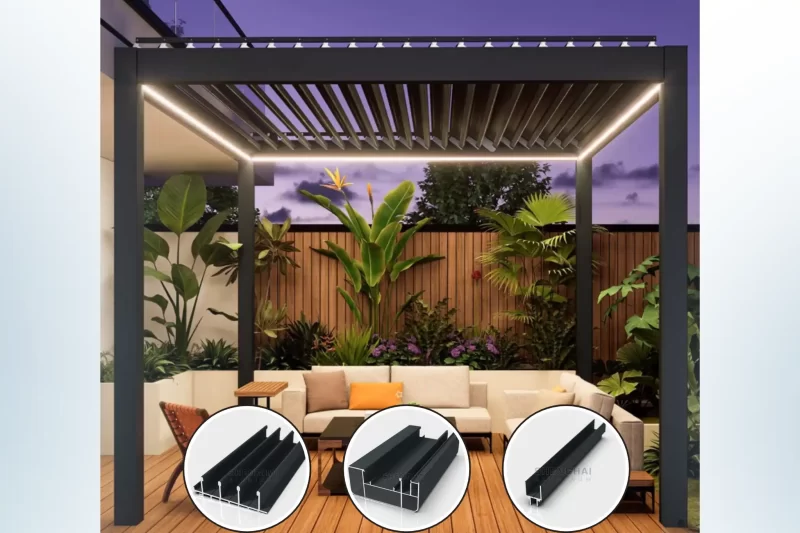
The seamless integration of LED lighting within the 6063-T6 framework maintains an atomically dense structure while extending the functional lifecycle of the outdoor space.
What materials can be used for the roof of an aluminum pergola?
1. Bioclimatic Louvers (The Correct Engineering Solution)
These 0-120° rotating slats utilize the chimney effect to vent hot air while maintaining shade. When closed, they lock into a waterproof surface. Lifespan: 20+ years.
2. Polycarbonate (The Budget Compromise)
It blocks UV but acts as a "heat trap." In summer, the area beneath becomes an unventilated oven. It also produces a rhythmic drumming sound during rain that is quite irritating.
3. Insulated Panels (Industrial Grade)
A "sandwich" structure designed for absolute temperature control. It doesn't allow light, but it provides extreme thermal resistance.
4. Fabric Canopies (Soft Furnishing)
Technically not a structure. Must be retracted during snow or wind to avoid deforming the frame.
5. Glass Panels (The Choice of Vanity)
Visually striking but physically heavy. It requires massive structural redundancy and creates a greenhouse effect that is intolerable in warmer latitudes.
How does the drainage system of an aluminum pergola with screens work?
- Interception: When the louvers close, their overlapping geometry creates a waterproof deck. Water is guided by gravity into perimeter gutters.
- Collection: The horizontal beams contain integrated troughs. These are not just structural; they are horizontal conduits that guide fluid toward the column interfaces.
- Evacuation: The hollow columns act as "invisible downpipes." This removes the need for unsightly external plumbing, maintaining the structural purity of the envelope.
According to its characteristics, what environments is it suitable for?
- Residential: Converting a garden from a "weather-dependent" space into a full-time living precinct.
- Commercial: Removing weather interference to maintain business ROI. Outdoor seating remains viable during rain or extreme sun.
- Coastal: Resisting the metallurgical challenge of salt-fog. Mandatory 6063-T6 and marine-grade coating required.
- Rooftop: Structural safety under extreme wind loads. Uses ZIP mechanical locks to ensure the pergola does not become a flying object.
Which countries is it suitable for?
In high-labor markets, this is a financial decision to avoid twenty years of maintenance costs.
- SE Asia & US South (Biodefense): Precision ZIP-track sealing to exclude insects in Thailand, Malaysia, and Florida.
- Europe & Australia (Thermal Management): Managing extreme UV in Germany, Slovakia, and Australia.
- Middle East & Mediterranean (Anti-Corrosion): Mandatory 25μm coating for UAE, Greece, and Spain.
- East Asian Cities (Structural Safety): Heavy-duty columns for high-rises in Hong Kong, Japan, and Singapore.